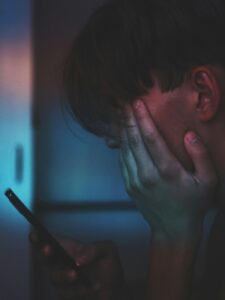
1. It disrupts your cortisol rhythm (the “alertness hormone”)
Around 6–8 a.m., your cortisol levels naturally peak — this is called the Cortisol Awakening Response (CAR). When this rhythm works properly, your focus and energy stay stable throughout the day.
But checking your phone immediately after waking exposes your brain to blue light and information overload, causing artificial stress. This can push cortisol too high or throw off the rhythm, making you feel tired in the afternoon.
→ A 2021 Journal of Clinical Endocrinology & Metabolism study also showed that smartphone blue light disrupts the morning cortisol pattern.
2. It damages your dopamine system (decision fatigue + faster addiction)
If you start your day with Instagram, YouTube, messages, or news, your brain gets dozens of tiny “rewards” in a very short time. Dopamine spikes and crashes repeatedly.
Over time, your dopamine baseline rises, so everything afterward — studying, working, exercising — feels less interesting.
→ Stanford’s Behavior Design Lab (BJ Fogg) has noted that “the first hour of the morning shapes dopamine sensitivity for the rest of the day.”
3. It drains your willpower (ego depletion)
Checking your phone in the morning forces your brain to make dozens of micro-decisions:
“Should I reply now?”
“This news is upsetting.”
“Am I supposed to live like this person?”
These emotional and cognitive mini-loads eat into your limited daily willpower.
Because willpower is a finite resource (Baumeister’s research), using it first thing in the morning means you start the day already mentally tired.
4. It delays your melatonin timing (worsens sleep quality)
If you get morning sunlight — even 5–10 minutes of ~10,000 lux — your melatonin cycle resets so that you feel sleepy again 14–16 hours later.
But when you rely only on indoor lighting and your phone screen, this reset signal becomes weak, and nighttime sleep gets worse.
→ A 2019 Chronobiology International study found that morning smartphone use delayed the biological clock by an average of 47 minutes.
5. It puts you into a “reactive mode” of living
When you start your day by checking other people’s messages, emails, or notifications, you begin the day following someone else’s agenda.
If you avoid your phone, you can ask yourself:
“What do I want to accomplish today?”
This helps you take control of your day. (Emphasized repeatedly in Cal Newport’s Deep Work and Andrew Huberman’s morning protocols.)
Conclusion & Practical Alternative
Try to avoid your phone for 30–60 minutes after getting out of bed.
Alternative routine:
-
Get sunlight
-
Drink a glass of water
-
Do light stretching or meditation
-
Write a 3-minute plan for your day